Why English Needed a Face
Emoji gets blamed for ruining English, but it might be doing something English writing never could: showing tone instead of just describing it.

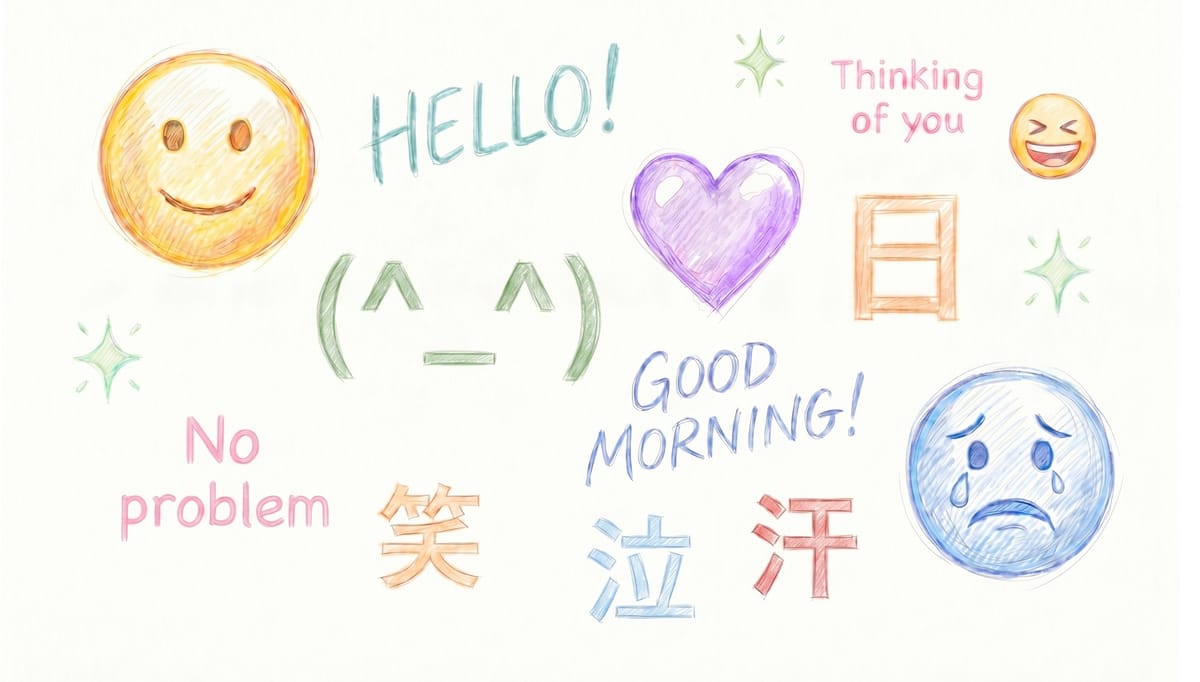
You've probably had this text exchange, or one just like it. A friend cancels plans last minute. You type "no worries" and stare at it for a second, because on its own, in cold black letters, it could mean anything from genuinely fine to I am seething. You add a 🙂. Suddenly it reads the way you meant it.
That tiny addition is the whole argument of this piece. Emoji get accused of dumbing down English, of being a lazy shortcut for people who can't be bothered to write a full sentence. I want to make the opposite case: emoji aren't degrading written English, they're filling a hole that was there long before smartphones existed, a hole other writing systems patched centuries ago.
A Word Doesn't Look Like What It Means
Here's a strange fact about English, and about most alphabetic writing, that's easy to miss because we're so used to it: there is nothing about the word "sad" that looks or sounds sad. Swap it for "triste" in French or "悲しい" in Japanese and it does exactly the same job, with exactly the same disconnect between the symbol and the feeling. Letters are just agreed-upon noise. They work because everyone agreed on the rules, not because they resemble anything.
Now look at 泣, the Japanese character for crying. It has water in it, literally, the radical on the left is the same water radical you'll find in 海 (ocean) or 汗 (sweat). Anyone who spends real time with kanji hits a moment where a character stops being an arbitrary shape to memorize and starts looking like what it means. It's a small shift, but it rewires how you think about writing. Suddenly a character isn't just standing in for a word, it's doing a little bit of showing as well as telling.
That's the gap. English writing runs almost entirely on symbols that don't resemble what they mean. It's been that way since the alphabet arrived, and it's a perfectly good system for a huge number of purposes. But it means written English has always had a harder time carrying tone, emotion, and nuance than systems with more pictorial DNA in them. 🙂 resembles a smile. "No worries" does not resemble reassurance. That mismatch has been quietly costing English speakers clarity for a very long time.
Manga Already Had the Code
Long before smartphones, Japan had already built a visual vocabulary for emotion that most readers absorbed without ever being taught it directly. Open a manga and you'll see a sweat drop appear over a character's head when they're nervous, a little popping vein when they're annoyed, or speed lines when someone's running. Nobody sits a new reader down and explains the sweat drop convention. You just pick it up, the same way you eventually understand that ALL CAPS means shouting.
That fluency with reading faces and symbols as information turned out to matter a lot, because it's exactly the skill two separate, unrelated inventions in Japan would go on to draw from.
The first was kaomoji. In 1986, a designer named Yasushi Wakabayashi posted (^_^) on a Japanese bulletin board system called ASCII NET, generally credited as the first kaomoji, a text face meant to be read straight on rather than sideways. This happened a few years after an American computer scientist, Scott Fahlman, proposed the sideways :-) on a Carnegie Mellon message board in 1982, as a way to mark jokes in technical posts where tone kept getting lost. Neither inventor knew about the other. Two writing cultures, working independently, hit the same wall, text has no face, and reached for two different features to fix it. Western emoticons lean on the mouth. Kaomoji lean on the eyes, which lines up with a broader cultural habit of reading emotion through someone's eyes rather than their mouth.
The second invention is the one most people know. In 1999, a designer named Shigetaka Kurita built a set of 176 tiny icons, each drawn on a 12 by 12 pixel grid, for the Japanese carrier NTT DoCoMo's new mobile internet service. He pulled from a few sources of inspiration: manga's visual shorthand, the Zapf Dingbats typeface, and the emoticons already floating around online. The goal, by his own account, was to bring some warmth into what felt like a cold, text-only digital space. That set of 176 little pictures is the direct ancestor of the thousands of emoji sitting in your phone's keyboard right now.
It's worth sitting with the fact that emoji isn't really a new idea. It's manga's visual grammar, condensed and exported.
From a Japanese Carrier to Everyone's Pocket
Emoji stayed mostly a Japanese phenomenon for about a decade. That changed once the Unicode Consortium, the body that standardizes how text displays across devices and languages, began folding emoji into its character sets around 2010. Apple built emoji support into iOS not long after. Once emoji could travel reliably between a phone in Tokyo and one in Toronto, the format stopped being a regional curiosity and became a default feature of digital communication everywhere.
It's a neat detail that English didn't invent a fix for its own gap. It imported one, wholesale, from a culture that had already been iterating on the problem for over a decade.
The Gap in English, Named Properly
Spoken English was never missing this stuff. A sarcastic sentence sounds different from a sincere one. A nervous laugh doesn't read the same as a confident one. Raised eyebrows, a pause, a half smile, all of that is doing real communicative work every time you talk to someone in person. Written English has never had a native way to carry any of it.
The old patches were arbitrary too, just like the alphabet itself. An exclamation point is a symbol about excitement, it doesn't look like excitement. ALL CAPS is a convention about volume. "Lol" is a stand-in for a laugh nobody actually types while laughing. These are all workarounds, agreed-upon shorthand bolted onto a system that was never built to carry tone in the first place.
Emoji is the first widely adopted patch that's actually iconic rather than arbitrary. 😂 doesn't represent laughter through convention, it resembles laughter. 😢 resembles crying the same way 泣 does. For the first time, English speakers have a native way to attach something that looks like the feeling, not just a symbol that means the feeling by agreement. That's a real structural upgrade, not a gimmick.
What Emoji Actually Does Well
A few places where this upgrade shows up clearly.
Disambiguating tone. "Sure, that works" reads completely differently with a 🙂 attached than with nothing at all, especially after a long pause in the conversation. Emoji removes a huge amount of the guesswork plain text forces onto the reader.
Working across language and literacy gaps. A 🎂 means birthday whether you're a fluent English speaker or someone who just learned their first fifty words. Pictographic communication has always traveled better across language boundaries than alphabetic writing does, which is a big part of why pictographic systems existed in the first place.
Matching the pace of the medium. Texting, messaging apps, and social platforms are closer to conversation than to formal writing: fast, informal, back and forth. Emoji fits that rhythm the way a raised eyebrow fits a conversation. It's quick, visual, and doesn't ask the reader to slow down and parse a full sentence to catch the tone.
Softening or sharpening intent. The exact same sentence can land as blunt or friendly depending entirely on what, if anything, follows it. "We need to talk." and "We need to talk 😅" are two very different messages, and the second one got there with a single character.
Where Emoji Doesn't Belong
None of this means emoji belongs everywhere, and it's worth being honest about that instead of overselling the case. Nobody wants 🎉 in a contract, a journal article, or a court filing, and for good reason. Formal writing exists precisely because some situations need precision, permanence, and a shared, unambiguous record, qualities a fast, informal, visually driven system isn't built to provide. Emoji is a conversational tool. It belongs in conversational spaces: texts, chats, casual emails, social posts. Outside of that sphere, it's noise at best and unprofessional at worst.
There's also a real ceiling on how much emoji can carry. It's very good at broad emotional strokes, joy, sadness, sarcasm, excitement, but it's not a substitute for actual descriptive writing when a situation calls for nuance, argument, or precision. Nobody is writing a business proposal in emoji, and nobody should.
Why It's Not Going Anywhere
Some people treat emoji as a fad a more literate generation will eventually grow out of. I'd bet against that. Emoji is baked into the infrastructure of digital communication now, not sitting on top of it as decoration. Unicode expands its emoji set every year. Every major platform, keyboard, and operating system ships with full emoji support by default. An entire generation has grown up texting in a mix of words and pictures and doesn't experience it as two separate systems at all, just as how you write to a friend.
Something that solves a real, longstanding gap in written communication, that's free to use, that travels across language barriers, and that's supported by every device on the planet isn't a trend. It's infrastructure.
The Face Writing Never Had
English speakers have been patching the same problem for centuries: how do you get tone, warmth, and emotion into a system built to record sound, not feeling. Punctuation helped a little. Capitalization helped a little. None of it ever really closed the gap, because none of it actually resembled what it was trying to convey.
Emoji does. It's not a corruption of written English, it's a solution English never had, borrowed from a writing culture that had been quietly working on the problem since 1986. The alphabet gave English precision. Emoji is finally giving it a face. 😊